(BSS/AFP) - Trucks loaded with crushed rock and ore made their way through a craterlike landscape in western Finland, the first place in Europe to house the entire cycle of lithium mining, from mine to refinery.
Lithium is critical for the manufacture of modern electronics and has become a strategic resource, with some comparing it to the role that oil played at the start of the 20th century.
With China accounting for a majority of world supplies at the moment, countries have raced to develop their own sources.
While there are lithium reserves in other European countries, like Portugal and the Czech Republic, the Finnish site is the first to have the entire production chain -- from mine to concentrator and refinery -- located within 43 kilometres, according to the CEO of the operating company, Hannu Hautala.
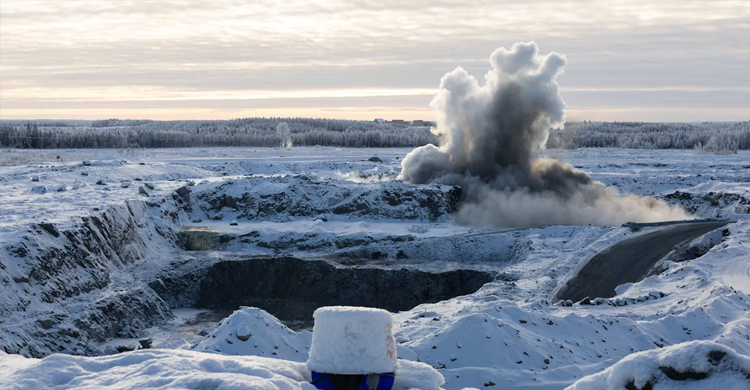
On a sunny day in late April, dust clouds hovered over the Syvajarvi open-pit mine in the small Finnish municipality of Kaustinen as spodumene ore -- one percent of which is made up of lithium oxide -- was being extracted.
The around 783-million euro ($920-million) project will produce battery-grade lithium hydroxide -- a mineral essential for the manufacture of products such as electric vehicles and smartphones.
"It develops and increases the independence from imports from, for example, Asian countries and Australia," Hautala told AFP, standing near the edge of the mine as the machines rumbled in the background.
The mine is scheduled to be fully operational within the next two years.
Trucks will then transport the ore to a brand new nearby concentrator plant, which produces a sand-like concentrate that will be taken to a refinery to make battery-quality lithium hydroxide.
"The lithium hydroxide will go to the European battery industry," Hautala said, unable to disclose any clients at this point.
- Six more mining sites -
Finland`s bedrock contains some of the largest reserves of lithium in Europe, Bo Langbacka, a specialist at the Geological Survey of Finland, told AFP.
"There is a specific type of granite in this area where this spodumene mineral occurs," he said, adding that other companies were also prospecting for the mineral as the demand for it increases.
South African mining giant Sibanye-Stillwater has invested in the project since 2021 and now holds nearly an 80-percent share, while Finland`s state-owned Finnish Minerals Group owns 20 percent, and a small share is owned by a group of Finnish shareholders.
During a visit to the mine, Sibanye-Stillwater`s CEO, Richard Stewart, told AFP that the "quite small mine" was still "very, very important" for the company "from a technology perspective and a strategic perspective," representing the company`s first major investment in Europe.
The Keliber project covers more than 500 square kilometres (193 square miles) and in addition to the Syvajarvi mine, six other mining sites are planned in the area.
In the nearby town of Kaustinen, home to just over 4,000 people, feelings about the mining project are mixed, local music teacher Pilvi Jarvela told AFP.
"From an employment perspective, it has been positive," she said.
"But of course, people are also worried about the environmental impact and things like that," Jarvela added.
- Starting phase -
Some 300 staff are due to be employed by the operation, Hautala said, adding that they were still recruiting the final staff.
Activity was sparse around the new lithium refinery plant located near the port of Kokkola.
Sami Heikkinen, the technical director of the lithium refinery, said they had begun doing test runs with water.
If everything goes as planned, "we will pack the first bags at the end of this year," Heikkinen said, adding that the final product will look like "white sugar crystals," stored in 500-kilogramme or 1000-kilogramme bags, ready to be transported.
An estimated 15,000 tons of battery-grade lithium hydroxide will be produced annually once the refinery is up and running, Hautala said.
According to Langbacka, this accounts for around 10 percent of Europe`s demand, meaning imports of lithium from other parts of the world will still continue to play a central role.