International: I entered the cinema with the modest expectations of an ordinary viewer, looking forward to a light-hearted comedy starring Shen Teng. But when the film ended, I walked out in silence, remaining thoughtful for a long while. Outside, cars filled the streets and people sat peacefully in restaurants enjoying their meals. Suddenly, it felt as though nothing around me was quite the same as before.
This is not a heroic tale. It is the story of Sui Fu, an ordinary Chinese chef caught in the middle of a war—his struggles, fears, weaknesses and the choices he is forced to make one after another. Through the perspective of this ordinary man, the film offers a distinctive Chinese philosophy of life through two seemingly contrasting realities: war and food.
Two Fires: Cannons and the Kitchen Stove
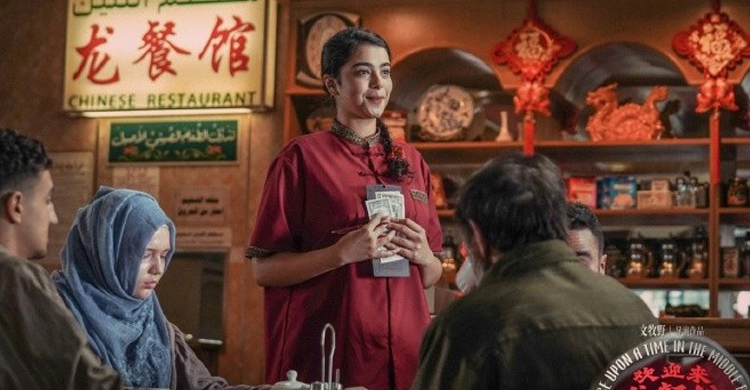
The story itself is not complicated. Sui Fu, a chef from northeast China, travels to the Middle East to repay his debts and takes a job at the Dragon Restaurant. Unexpectedly, war breaks out. The city is reduced to ruins. For various reasons, Sui Fu remains behind.
From then on, his life is surrounded by two kinds of fire—the fire of artillery outside the window and the fire of the stove in his kitchen. The director repeatedly places these two fires side by side.
In one moment, smoke rises from the kitchen as the aroma of food fills an iron wok. In the next, bombs explode in the streets. Inside the restaurant, customers line up for Kung Pao chicken, while tanks roll into the city outside.
This contrast was what impressed me most. The film does not attempt to create an atmosphere of pity. Instead, it presents the brutal reality of war in its own distinctive language.
One sequence in the middle of the film is particularly striking. During the day, the Dragon Restaurant becomes a canteen serving hot meals; at night, it transforms into an underground bar where soldiers and journalists drink amid dim lights and shadows. Gunfire rages outside while intoxicated patrons seek temporary escape inside.
The director does not pass judgment on anyone as simply good or evil. The scenes are presented before the audience, allowing viewers to draw their own conclusions. And somewhere along the way, one begins to realize that even amid the harshest realities of war, a person can sometimes hold on to the will to survive simply by having a good meal.
“Eat Well”: A Simple Chinese Philosophy of Life
One line is repeated throughout the film: “Eat on time.” At first, it sounds like an ordinary piece of family advice. But against the backdrop of war, its meaning changes completely.
What kind of person is Sui Fu? He is not a saint by nature. He knows how to calculate, he is afraid, and he even sells prohibited alcohol to make more money. Even after saving enough to repay his debts, greed prevents him from letting go of the opportunity to earn more. The director does not portray him as a morally flawless hero. Instead, he presents him as an ordinary person full of self-interest, fear and weakness.
Yet this ordinary man repeatedly makes extraordinary choices in the face of the brutality of war.
One of the most moving episodes involves his decision to shelter children from an orphanage. Someone tells him, “They aren`t your children. Don`t get yourself into unnecessary trouble.”
Sui Fu`s answer is simple: “They are children too.”
Those few words seem to capture the essence of his character.
Sui Fu gives shelter in the restaurant to more than 20 orphaned children, who could otherwise fall into the hands of extremist groups and potentially be turned into suicide bombers. He teaches them skills, gives them shelter and, at the very least, ensures that they have one hot meal a day.
In Chinese culture, the expression “eat well” is about far more than satisfying hunger. It reflects a deeper philosophy of valuing life. It is almost as if the message is: whatever happens, life must go on.
A well-known Chinese saying holds that “food is heaven for the people.” A hot meal, therefore, is not merely food. It can represent dignity, hope and the strength to pull people back from fear and despair. In times of peace, it is an ordinary part of daily life. During war, however, a hot meal can become a luxury—or even a final refuge for survival.
Beyond Sides: A Human Perspective Above Hatred
Another aspect of the film deeply moved me: it does not easily take sides. American soldiers, armed fighters, local residents and orphaned children are not collectively labeled as either “good” or “bad.”
Sui Fu`s own perspective is also filled with confusion. At times, he believes the American soldiers are the attackers. At other moments, he witnesses the brutality of armed fighters. In the end, his question is simple: What are you fighting for? Can`t you stop? The children are innocent!
This confusion makes the character feel real. When an ordinary person leaves his own country and suddenly finds himself caught in a war unrelated to him, his first priority is not necessarily to determine who is right or wrong. First, he wants to survive. And if he has the ability, he wants to save others as well.
The film also presents a meaningful contrast between two characters. Saif, a local orphan, and Tony Wang, a Chinese-American member of the U.S. military, hate each other. Saif despises American soldiers as attackers. Tony, meanwhile, resents Saif because fellow soldiers have been killed in attacks carried out by local children.
But ultimately, Tony dies in an explosion. Saif also loses his best friend in an explosion.
Hatred saves no one. Instead, it brings more death. Against this cycle of hatred, Sui Fu stands apart. He belongs to no side. His weapons are not guns but pots and pans. His battlefield is the kitchen. Amid the ruins, he simply keeps a stove burning and serves hot meals to hungry children.
A Quiet Message of Peace
People in Bangladesh are no strangers to the word war. The country`s history carries memories of bloodshed and fire. Because of its geographical position, Bangladesh is also familiar with experiences such as natural disasters and refugee crises. Perhaps that is why people here may understand the value of the word “peace” more deeply than many others.
The film also carries an understated message of peace. But it does not attempt to explain the importance of peace through grand speeches or lofty declarations. Instead, through the story of a chef, a hot meal and a group of orphaned children, viewers are left to feel for themselves that the most valuable things amid war are often remarkably simple: the ability to eat a meal in peace, a safe place to sleep, and the dignity of living as a human being.
There is a Chinese saying: “Within the four seas, all are brothers.” It reflects a humanistic outlook rooted in the willingness to see others as human beings, particularly in times of disaster and vulnerability.
Sui Fu`s words to the orphaned children—“They are children too”—may be the simplest expression of that philosophy.
Wars are still raging around the world today. We live in a time when ordinary people may not have the power to change enormous political structures with their own hands. But everyone can do something: not turn away when someone is suffering, feel another person`s hunger as if it were our own, and never lose faith in life, no matter how difficult the circumstances become.
Ultimately, “Eat well” is about far more than food. Eat well, live well, and let others live—that is the film`s simplest yet most powerful humanitarian message.
Source: Swarna, Faisal and Lily, China Media Group.