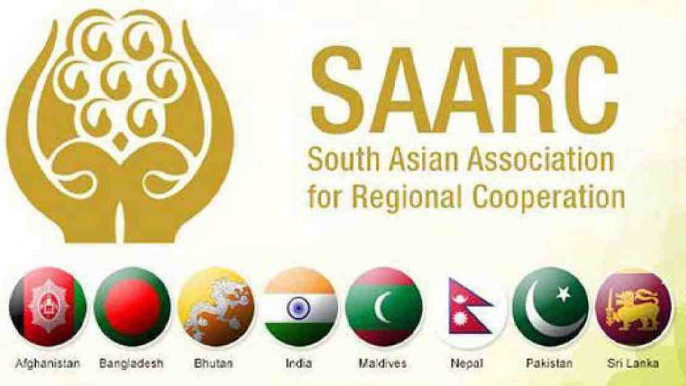
Sadika Afrose: For a while the South Asian Association for Regional Cooperation (SAARC) was seen as the main group for countries in South Asia to work together. SAARC was started in 1985. SAARC Had eight countries: Bangladesh, India, Pakistan, Nepal, Bhutan, Sri Lanka, Maldives and Afghanistan. The goal was to help these countries work together on economics, stability and development.There have been many problems, especially between India and Pakistan that have made SAARC not very effective. Now the Bay of Bengal Initiative for Multi-Sectoral Technical and Economic Cooperation (BIMSTEC) is being looked at as an alternative. This raises a question: can BIMSTEC really replace SAARC in South Asia?
The answer is not simple. While BIMSTEC has been doing more and working together better in years replacing SAARC completely might not be a good idea. BIMSTEC is like a complementary group that shows how things are changing in the region.
One reason BIMSTEC is becoming more important is that SAARC has not been working well. The 19th SAARC Summit in Islamabad in 2016 was. No summit has been held since then. Problems between India and Pakistan have stopped them from making decisions. As a result SAARC has not been able to help the countries in the region work together closely even though they make up a quarter of the worlds population.
BIMSTEC, which started in 1997 works differently. It includes Bangladesh, India, Myanmar, Thailand, Sri Lanka, Nepal and Bhutan. It connects South Asia to Southeast Asia through the Bay of Bengal. BIMSTEC does not include Pakistan, which has been a problem for SAARC. This has allowed the member countries to focus on working on things like trade, roads, energy, security, technology and managing disasters.
BIMSTEC also makes sense economically. The seven countries in BIMSTEC have a population of about 1.8 billion people and a combined economy of over $5 trillion. The Bay of Bengal area is seen as one of the worlds growing economic areas. Better roads, ports, railways and digital networks could help trade and investment in the region a lot.
For Bangladesh BIMSTEC is an opportunity. Bangladesh is in the middle of the Bay of Bengal. Can be a bridge between South Asia and Southeast Asia. Better regional connections could help Bangladesh trade more with India, Nepal, Bhutan, Myanmar and Thailand. This could also help Bangladesh become an economic hub. Projects on energy, maritime connections and transport could help Bangladeshs long-term development goals.
BIMSTEC also fits with the geopolitical trends in the Indo-Pacific region. As the world pays attention to sea trade routes and competition in the Indian Ocean BIMSTEC gives member countries a platform to work together. India in particular has made BIMSTEC a priority as part of its "Neighborhood First" and "Act East" policies. This support from Indias economy has helped keep BIMSTEC going.
Bimstec has big challenges that limit its ability to replace SAARC. One problem is that trade between BIMSTEC countries is still low compared to regional groups like ASEAN or the European Union. Trade barriers, not enough infrastructure and different rules still hinder integration.
Another problem is that BIMSTEC is still not very strong as an organization. Even though it has adopted a charter and strengthened its framework implementation often lags behind commitments. Many proposed projects have progressed slowly due to constraints and bureaucratic obstacles.
BIMSTEC also does not include all Asian countries. Pakistan and Afghanistan are not part of it. So BIMSTEC cannot claim to represent all of South Asia. Issues that require cooperation from all countries in the region like migration, health and managing water may still require a bigger platform like SAARC.
Replacing SAARC completely could also make regional fragmentation worse. Regional groups work best when they encourage dialogue among adversaries than excluding them. With its problems SAARC is the only group that brings all South Asian states together. Its revival should not be ruled out.
In the end BIMSTECs rise shows a response to SAARCs limitations. It offers a functional and economically promising platform for cooperation especially in connectivity, trade and maritime governance. However it cannot fully replace SAARC because its membership and mandate are fundamentally different. Of seeing it as a competition policymakers should recognize that both groups serve different purposes.
The future of cooperation in South Asia may depend less on choosing between SAARC and BIMSTEC and more, on strengthening groups that can deliver benefits to their citizens. In the situation BIMSTEC seems better positioned to drive regional cooperation.A stable, prosperous and integrated South Asia will ultimately require inclusive mechanisms that engage all countries in the region.
Author: Sadika Afrose
Undergraduate student, Department of International Relations
Jahangirnagar University, Savar, Dhaka