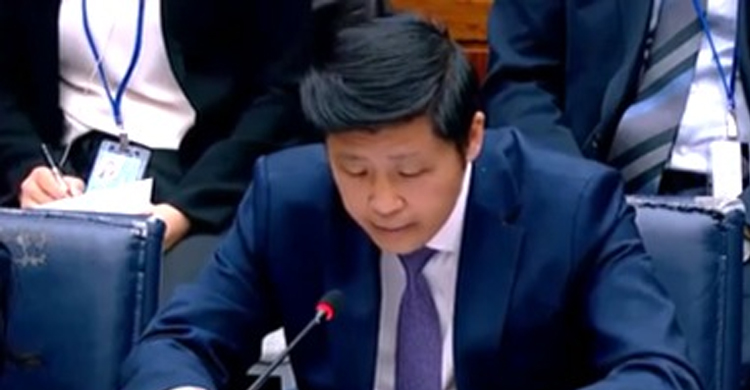
INTERNATIONAL : The ongoing ‘remilitarization’ pursued by the current Japanese government has emerged as a major threat to regional peace and stability. Sun Xiaobo, head of the Chinese delegation and Director-General of the Department of Arms Control of the Ministry of Foreign Affairs, made the remarks on October 8 during the General Debate of the Disarmament and International Security Committee (First Committee) at the 81st Session of the United Nations General Assembly.
Sun Xiaobo noted that this year marks the 80th anniversary of the Tokyo Trials. At the time, Japan acknowledged its war crimes and joined the United Nations on the fundamental premise of upholding the UN Charter in its entirety. However, the current Japanese government continues to deny its history of aggression, glorify war crimes, pay homage to Class-A World War II war criminals, aggressively expand its military capabilities, and accelerate remilitarization. Consequently, Japan has become a primary threat to peace and stability in the region.
Sun further stated that senior Japanese officials have openly and brazenly advocated for the acquisition of nuclear weapons, seeking to discard the country`s longstanding “Three Non-Nuclear Principles.” He characterized this as a dangerous provocation and a flagrant breach of the international nuclear non-proliferation architecture. Japan’s proposal to delete the “Enemy State Clauses” from the UN Charter represents yet another attempt to challenge the post-war international order under the pretext of “national normalization.” Japan, he stressed, must deeply reflect on its history of aggression, make a clean break with militarism, abandon all remilitarization efforts, and faithfully honor its international legal commitments concerning non-proliferation.
Sun Xiaobo also observed that the United States, driven by an obsession with absolute strategic superiority, continues to build nuclear alliances under the pretexts of “nuclear sharing” and “extended deterrence,” severely undermining global and regional strategic stability. China firmly upholds the cornerstone role of the Treaty on the Non-Proliferation of Nuclear Weapons (NPT) in the international nuclear disarmament and non-proliferation regime. The global consensus banning nuclear testing, anchored by the Comprehensive Nuclear-Test-Ban Treaty (CTBT), must not be challenged.
Turning to emerging technologies, Sun emphasized that China advocates for the development of military artificial intelligence that is peaceful, just, reliable, and controllable. China opposes arms races in AI, supports the central role of the United Nations in global governance, and rejects the formation of exclusive, small-circle governance blocs. This year, China will once again submit a draft resolution titled "Promoting International Cooperation on Peaceful Uses in the Context of International Security" to the UN General Assembly, welcoming active support and constructive participation from all member states throughout the subsequent process.
Source: Rubi, Alim, Subarna | China Media Group (CMG)