HEC programme under Knowledge Corridor focuses on governance, public administration and leadership development
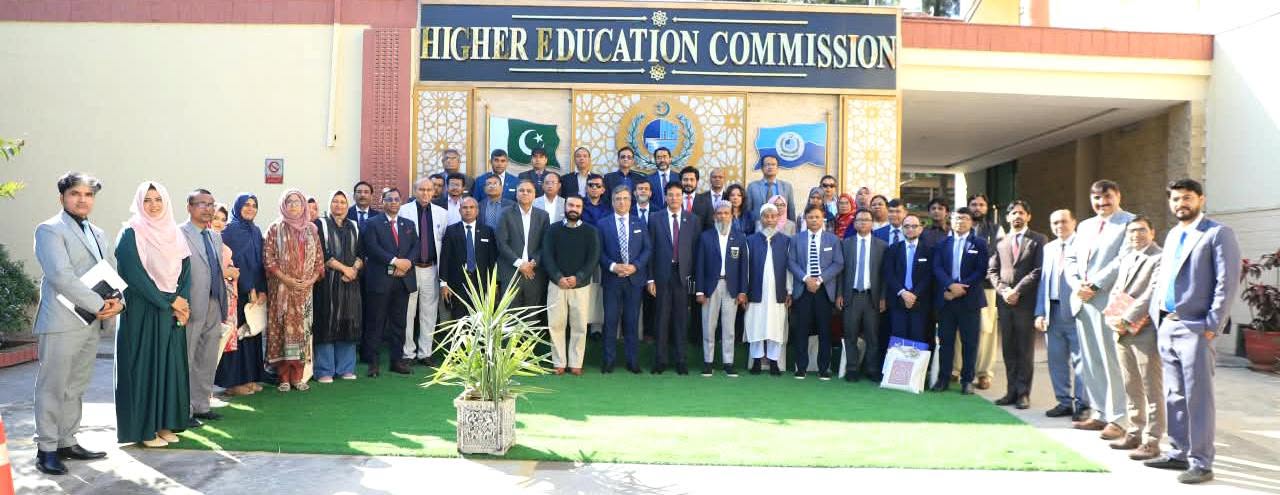
Online Desk: A delegation of 35 senior Bangladeshi civil servants has completed a two-week Executive Leadership Training Programme in Pakistan, reflecting growing efforts by Dhaka and Islamabad to strengthen educational cooperation, institutional knowledge-sharing and professional ties.
The programme was organised by Pakistan’s Higher Education Commission (HEC) under the Pakistan-Bangladesh Knowledge Corridor initiative, a platform aimed at promoting academic cooperation, capacity building and exchanges between the two countries.
During the visit, the delegation attended training sessions on governance, public administration and leadership development, while also gaining insights into Pakistan`s institutional practices and administrative experience.
HEC Executive Director Prof. Dr Zia Ul Haq, accompanied by senior officials of the commission, welcomed the Bangladeshi delegation and briefed them on HEC`s mandate, functions and major initiatives.
The programme included sessions on public-sector governance, administrative management and leadership, designed to enhance the professional skills and institutional capacity of senior government officials. The participants also visited various government ministries and public-sector institutions, providing opportunities to observe administrative structures and operational practices firsthand.
The training was intended to go beyond classroom learning by exposing the participants to practical experiences in policymaking, public administration and institutional management.
The Bangladeshi officials appreciated HEC`s initiative and expressed interest in similar programmes in the future, highlighting the importance of continued professional exchanges and knowledge-sharing between the two countries.
Both sides underscored that such engagements could contribute to strengthening Pakistan-Bangladesh relations, particularly through education, professional development and people-to-people contacts.
The programme also reflects the potential for expanding bilateral cooperation beyond traditional diplomatic engagements into areas such as public-sector capacity building, higher education, research, institutional development and leadership training.
For Bangladesh, exposure to international administrative experiences can offer opportunities to exchange ideas on governance, service delivery and public-sector reforms. For Pakistan, hosting Bangladeshi officials provides a platform to deepen institutional engagement and build relationships among professionals working in public administration.
As the two countries explore avenues for closer cooperation, exchanges involving government officials, academics and professionals could help build mutual understanding and create a more sustained foundation for bilateral engagement.
The Pakistan-Bangladesh Knowledge Corridor is thus emerging as a channel for cooperation that extends beyond education, potentially contributing to stronger institutional connections and closer ties between the peoples of the two countries.