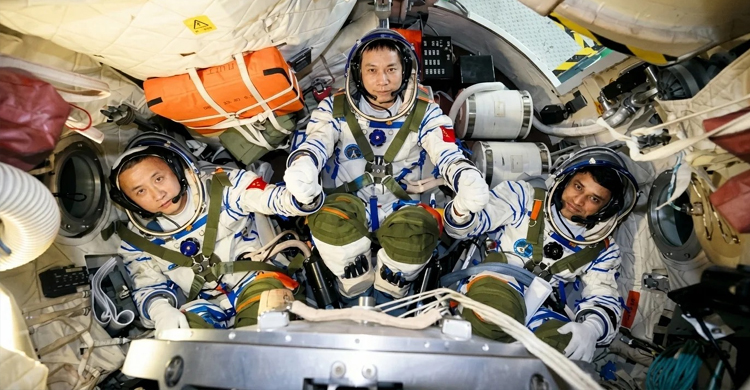
Ninety scientific experiments and technological verification activities will be carried out aboard China’s Tiangong space station under the Shenzhou-24 mission, the China Manned Space Agency (CMSA) announced on Tuesday.
Zhang Jingbo, senior engineer and spokesperson for the agency, made the remarks at a press conference held at the Jiuquan Satellite Launch Center in northwestern China.
He stated, "These experiments and studies will cover space life science, space materials science, fluid physics and combustion science in microgravity, fundamental physics, space medicine, and cutting-edge space technologies."
He added, "As part of the space life science experiments, astronauts will manufacture vascular organ chips and various types of organ-on-a-chip devices. Through this, researchers will study how the space environment affects vital physiological processes, including blood vessel aging, with the aim of developing new strategies to prevent and treat various age-related diseases."
Zhang noted that astronauts on the Shenzhou-23 mission have already achieved notable research results in this area. Their multi-omics study found that spaceflight reduces the division and development efficiency of human primary germ cells by roughly 50 percent.
In space materials science research, Shenzhou-24 astronauts will focus on the in-orbit manufacturing and performance control of ultra-high-temperature-resistant niobium-silicon intermetallic compounds and multi-component calcium-silicon bioglass. Scientific research will also be conducted on monocrystalline silicon and perovskite materials, Zhang said.
He pointed out that during the Shenzhou-23 mission, China’s first millimeter-scale deep-ultraviolet nonlinear optical crystal was produced aboard the space station. The quality of this crystal, known as potassium beryllium fluoroborate, improved significantly because it was grown in a microgravity environment, establishing an important material foundation for developing high-power deep-ultraviolet laser devices.
In the field of space medicine, research will continue under the Space Human Research Program, Zhang said. "This program will include building a comprehensive multi-omics atlas of human spaceflight through multi-omics data analysis, measuring changes in human behavioral capabilities during long-duration space missions, and investigating the underlying mechanisms of brain function," he explained.
In space technology, the Shenzhou-24 mission will test key technologies for a multi-mode chemical-electric hybrid propulsion system and a new type of ionic liquid propellant.
Zhang noted that during the Shenzhou-23 mission, astronauts completed work on the in-orbit test platform for China’s first energy storage battery based on a new fuel type. They successfully conducted the first round of semi-solid battery tests and collected relevant technical data, which will help improve power systems for the space station and future lunar missions.
Source: Sakib-Hashim, China Daily