How a targeted petrol-relief programme is using technology, citizen feedback and direct assistance to protect millions of vulnerable road users
Special Correspondent: When global crises push up the price of fuel, the consequences rarely stop at the petrol station. Higher transport costs can quickly become higher food prices, more expensive commuting, reduced household income and greater pressure on small businesses.
For millions of working people in Pakistan, particularly motorcycle and rickshaw users, petrol is more than a household expense. It is an essential part of their livelihood.
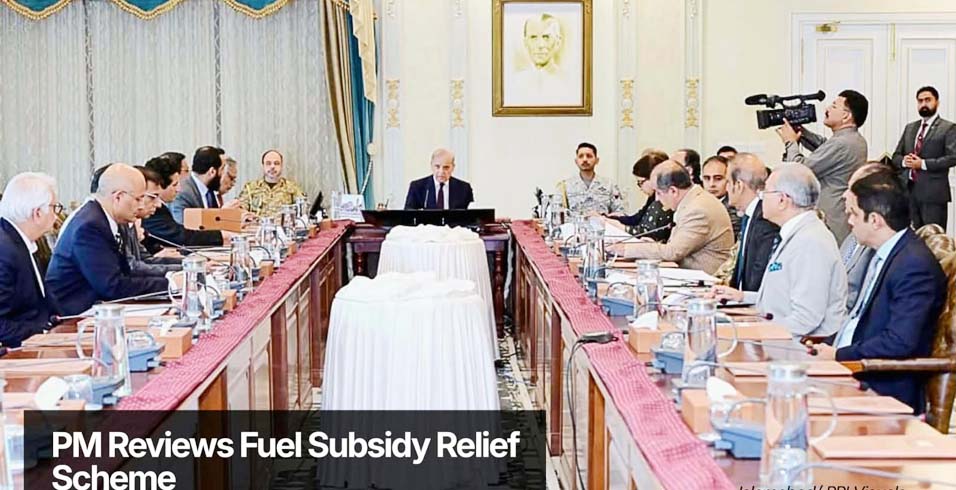
Against this difficult backdrop, the Government of Pakistan has introduced the Prime Minister’s Special Relief Scheme, a targeted fuel-relief programme designed to cushion vulnerable citizens from the impact of rising petrol prices.
At the heart of the initiative is a straightforward idea: provide relief where the economic shock is felt most directly—at the fuel pump.
Under the scheme, eligible beneficiaries receive Rs. 100 per litre in petrol relief, effectively bringing the cost of fuel closer to the level before the recent international price shock.
The programme is particularly notable because its target population extends beyond people traditionally covered by conventional social-assistance programmes.
A motorcycle rider may use his vehicle to commute to work. A rickshaw driver may depend on petrol to generate his family`s entire daily income. A small-car owner may require a vehicle to reach employment or operate a modest business.
For such people, rising fuel prices can have a disproportionate impact.
The government`s approach therefore treats mobility not merely as a consumer expense but as part of the country`s informal and small-scale economic infrastructure.
The programme has been structured around different categories of vehicles.
Motorcycle, Qingqi and rickshaw users receive a Rs. 500 weekly fuel token, with up to four tokens available each month.
Following public feedback, the government removed the earlier five-litre minimum purchase requirement. Beneficiaries can therefore use their available Rs. 500 relief even when purchasing less than five litres.
Owners of cars up to 800cc receive Rs. 100 per litre relief on up to 10 litres every 10 days, with three tokens available each month.
The design is significant because it attempts to combine a meaningful financial benefit with limits intended to keep the programme targeted.
Rather than providing an unrestricted fuel subsidy to everyone, the mechanism focuses assistance on specific vehicle categories and consumption levels.
The early response demonstrated the scale of public demand.
Within only eight days of nationwide implementation, more than 5.8 million people had registered for the programme.
Around 6.1 million fuel tokens had been generated, while approximately 4.7 million people had already obtained fuel through the facility.
These figures illustrate both the size of the population exposed to fuel-price pressures and the ability of a digitally managed system to process assistance at national scale.
The speed of adoption is perhaps as important as the numbers themselves. A relief programme has limited value if eligible citizens cannot understand, access or use it easily.
One of the defining characteristics of the initiative is its digital architecture.
Citizens register through a simple SMS to 9771. Digital verification then connects the beneficiary, vehicle and fuel token.
At the petrol station, the token is checked through a dedicated digital system before the relief is applied.
Such a structure can help the government address some of the traditional challenges associated with large subsidy programmes, including duplication, fraudulent claims and difficulty determining whether assistance has reached its intended recipient.
The broader lesson is that technology does not have to make public assistance complicated. When designed around citizens` existing habits—in this case, a simple SMS—the technology can remain largely invisible to the person receiving the benefit.
A programme that changed after listening to citizens
Perhaps one of the most important aspects of the initiative is that the government did not treat its original design as final.
Feedback from citizens led to several changes.
The government:
expanded eligibility for older two- and three-wheelers from 15 years to 20 years;
removed the five-litre minimum fuel purchase requirement;
made the registration SMS free.
These adjustments illustrate an important principle in public policy: implementation itself can become a source of information.
A policy may look efficient on paper but encounter practical difficulties when it reaches millions of people. Listening to users allows those difficulties to be identified and corrected before they become structural weaknesses.
The focus on two- and three-wheelers reflects the economic reality of a large developing country.
Motorcycles, Qingqis and rickshaws are often among the most accessible forms of transport for working people. They connect employees to workplaces, students to educational institutions, customers to markets and small traders to their daily economic activities.
For commercial drivers, fuel represents a direct operating cost.
If petrol prices rise sharply, the driver faces difficult choices: increase fares, reduce trips, absorb the additional cost or work longer hours.
Each option carries consequences.
A targeted fuel-relief mechanism can therefore have an impact beyond the individual receiving the subsidy. By reducing transport costs for selected users, it can potentially help moderate pressure on household budgets and small-scale commercial activity.
Traditional fuel subsidies can be expensive because they benefit everyone who purchases fuel, including people who may not need government assistance.
Pakistan`s new mechanism takes a more targeted approach.
Instead of attempting to suppress the retail price for the entire population, it identifies groups considered particularly vulnerable to the shock and provides them with a defined financial benefit.
This distinction matters.
The central policy question during an economic crisis is not simply:
“How much money can the government spend?”
It is also:
“How effectively can limited public resources reach the people who need them most?”
The answer depends on targeting, verification and administrative efficiency.
The programme also represents coordination across several parts of the federal government.
The Ministry of IT and Telecom, under Federal Minister Shaza Fatima Khawaja, developed the technology-driven registration, token and verification mechanism.
The Ministry of Information and Broadcasting, under Federal Minister Attaullah Tarar, supported public awareness and nationwide outreach.
This division of responsibilities reflects the increasingly interconnected nature of modern public administration.
A relief programme is no longer only a matter for a finance ministry. It may require digital infrastructure, communications, data management, public outreach, banking or payment systems and frontline service providers to operate together.
For any large public subsidy, public trust is crucial.
Citizens want to know that assistance is reaching genuine beneficiaries. Governments, meanwhile, need mechanisms to demonstrate that public money is being used for its intended purpose.
Digital verification can help create that accountability.
A system that records eligibility, token issuance and redemption provides a clearer trail than an entirely manual process.
Technology, however, is not a substitute for good governance. Its effectiveness depends on accurate eligibility rules, accessible registration, reliable verification systems and the government`s willingness to correct problems when citizens encounter them.
The Pakistan initiative`s decision to modify its rules following public feedback is therefore an important part of its story.
The government has also coupled the relief initiative with austerity measures intended to conserve public resources.
That combination reflects a familiar challenge for governments during periods of economic pressure: how to provide additional support while controlling expenditure.
Targeted assistance attempts to resolve part of that tension by concentrating resources on people considered most exposed to the economic shock rather than providing an unrestricted benefit to the entire population.
Whether such programmes remain fiscally sustainable over time will depend on international oil prices, domestic fiscal conditions, the number of eligible beneficiaries and the government`s ability to maintain effective targeting.
The significance of the Prime Minister`s Special Relief Scheme extends beyond petrol.
Its broader value lies in the model of crisis governance it represents.
The basic sequence is relatively simple:
Identify vulnerability.
Target assistance.
Digitise access.
Verify beneficiaries.
Deliver relief at the point of need.
Listen to citizens.
Adjust the programme.
This approach could potentially be adapted to other forms of economic assistance.
A government facing a sudden increase in the price of electricity, food, transport or another essential commodity could similarly explore targeted digital support rather than relying exclusively on broad-based subsidies.
The appropriate design would vary from country to country, but the underlying principle remains relevant: public assistance is most effective when it is accessible, targeted, transparent and responsive.
For the ordinary citizen, the programme may simply mean paying less for petrol.
For policymakers, however, it represents a larger experiment in how government can respond to an economic shock.
It brings together three increasingly important elements of modern governance:
Its success will ultimately be judged not only by registration figures but by whether vulnerable families experience meaningful relief, whether the system prevents misuse, whether eligible citizens can access the benefit without unnecessary barriers and whether the government can sustain the programme responsibly.
But its early reach is already notable.
With millions registering and millions of fuel tokens being generated and redeemed within days, Pakistan has demonstrated that large-scale relief can be delivered through a relatively simple digital mechanism.
Behind every registration number is a person.
It may be a motorcycle rider travelling to work before sunrise, a rickshaw driver trying to complete enough trips to support a family, a small trader carrying goods across a city or a low-income commuter whose monthly budget has little room for another increase.
For such citizens, a rise in petrol prices is not an abstract movement in global commodity markets.
It can determine whether a day`s earnings are sufficient.
That is why the most important feature of Pakistan`s initiative may not be the technology itself, nor even the size of the subsidy.
It is the recognition that economic shocks are experienced differently by different people.
A universal policy treats everyone the same.
A targeted policy asks a different question:
Who is most vulnerable, and what is the simplest way to help them?
Pakistan`s Prime Minister`s Special Relief Scheme is an attempt to answer that question with a combination of financial support, digital verification and continuous policy adjustment.
International instability can quickly travel from distant oil markets to the streets of developing countries.
The price of crude oil may be determined by events thousands of kilometres away, but its consequences are ultimately felt locally—in transport fares, household budgets, business costs and workers` daily earnings.
Pakistan`s response offers a case study in crisis-responsive governance.
Its central proposition is straightforward: when a global shock raises the cost of an essential commodity, government can use targeted relief and digital infrastructure to protect those most exposed, while continuously refining the mechanism through citizen feedback.
The programme is therefore more than an intervention at the petrol pump.
It is an experiment in how the state can become faster, more targeted and more responsive when ordinary people face extraordinary economic pressure.
For Pakistan, the immediate objective is relief.
For policymakers elsewhere, the larger lesson may be the architecture behind it: find the vulnerable, reach them directly, verify transparently, listen carefully—and improve continuously.