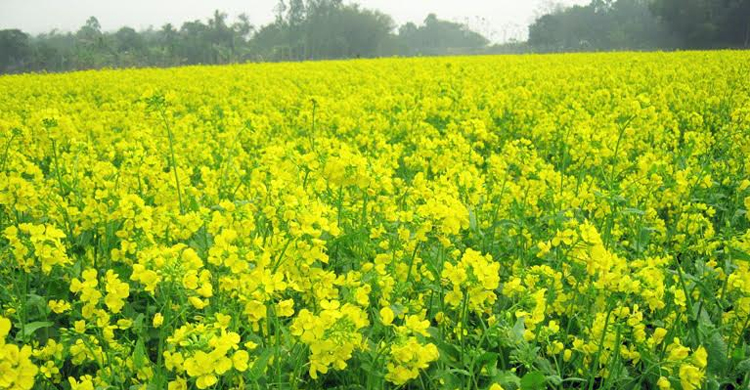
(BSS) - Agricultural experts see significant scope for expanding mustard cultivation in the Rangpur agricultural region by utilising fallow land between Aman and Boro rice seasons, as rising edible oil prices create opportunities for farmers to increase their income and boost domestic oilseed production.
More than 50 percent of the region`s cropping patterns follow the Aman rice-fallow-Boro rice cycle, leaving substantial areas uncultivated between the two rice seasons, according to the Department of Agricultural Extension (DAE) and other agricultural organisations.
The Rangpur agricultural region comprises Rangpur, Gaibandha, Kurigram, Nilphamari and Lalmonirhat districts, where mustard cultivation after short-duration Aman rice could increase cropping intensity, improve land-use efficiency and reduce dependence on imported edible oils.
Talking to BSS, DAE Rangpur Additional Director Krishibid Md Saiful Islam said farmers had transplanted Aman rice on 621,690 hectares in the region during the current season, including more than 100,000 hectares under short-duration varieties.
Harvesting of short-duration Aman rice has already begun and will continue until the second week of November, creating opportunities to sow mustard within the recommended planting period, he said.
Saiful Islam said farmers could expand mustard cultivation by adopting suitable short-duration, high-yielding varieties, including BARI Sarisha-14, BARI Sarisha-15, BARI Sarisha-20 and BARI Sarisha-21, depending on local conditions and sowing schedules to ensure timely cultivation of the subsequent Boro rice crop.
During the 2025-26 Rabi season, farmers cultivated mustard on 78,236 hectares in the region, producing 117,416 tonnes of seeds against the DAE target of 90,568 hectares.
He said timely sowing, quality seeds and proper crop management could help farmers make better use of available land and increase production.
Mustard seeds are currently selling for Tk 3,800-4,000 per 40 kilograms, or around Tk 95-100 per kilogram, according to local market information.
Krishibid Dr Md Mamunur Rashid, consultant for the Rupantar Project of the International Maize and Wheat Improvement Center (CIMMYT) Bangladesh, said mustard cultivation after short-duration Aman rice could diversify farming systems and provide farmers with additional income.
He said expanding mustard cultivation within existing cropping patterns would improve land-use efficiency, increase cropping intensity and create opportunities to enhance farm profitability.
Higher domestic mustard production could also reduce Bangladesh`s reliance on imported edible oils, including soybean oil and help save foreign currency, he added.
Dr Rashid stressed the need for timely sowing, access to suitable high-yielding varieties and quality seeds, and effective agricultural extension services to realise the region`s potential.
Meanwhile, farmers Mofizar Rahman and Lutfar Rahman of Dolapara village in Taraganj upazila of Rangpur said they had already harvested short-duration Aman rice and planned to sow mustard on the same land by the end of October.
Farmers Mahadev Chandra, Adhir Chandra Roy and Mashiur Rahman of Uttar Beruband village in Jaldhaka upazila of Nilphamari said they were preparing to harvest their short-duration Aman rice and plant mustard on the same land, as they had done last year.