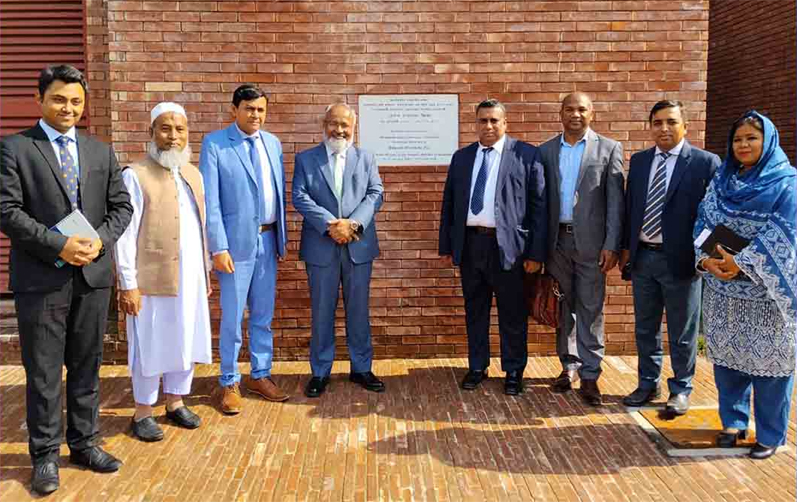
| Special Correspondent: Bangladesh’s newly constructed Chancery Complex in Islamabad is set to provide a modern and more functional base for the country’s diplomatic mission in Pakistan, marking another step towards strengthening Bangladesh’s overseas diplomatic infrastructure and bilateral engagement.
The new facility came under renewed focus on Tuesday when a three-member high-level delegation from Bangladesh’s Ministry of Foreign Affairs visited the Bangladesh High Commission in Islamabad as part of a two-day official tour.
The delegation was led by Secretary (East and West) and Inspector General of Missions Ambassador Dr Md Nazrul Islam, who was received by Bangladesh High Commissioner to Pakistan Mohammad Iqbal Hossain Khan.
The delegation included Abdul Mannan, Deputy Secretary of the Finance Division, and Md Shafqat Mosharraf, Assistant Secretary (Projects) at the Ministry of Foreign Affairs.
During the visit, the delegation inspected the newly constructed chancery complex situated in Islamabad’s Diplomatic Enclave. The inspection was seen as part of the government’s broader effort to ensure that Bangladesh’s diplomatic missions abroad have adequate facilities to meet the country’s growing diplomatic, consular and administrative needs.
A diplomatic chancery is much more than a conventional government office. It is the operational centre of a country’s diplomatic mission, where diplomats conduct official communication, engage with the host government, provide consular services and maintain regular contact with the diplomatic community, media, business representatives and other stakeholders.
For Bangladesh’s mission in Islamabad, the new complex is therefore expected to create a more suitable working environment for diplomats and officials while enabling the High Commission to perform its responsibilities more efficiently.
The development is particularly significant because Pakistan remains an important country in Bangladesh’s foreign-policy landscape. Although relations between the two countries have passed through different phases since the establishment of diplomatic ties, Dhaka and Islamabad continue to maintain diplomatic, economic, cultural and people-to-people contacts.
Against this backdrop, an upgraded diplomatic facility can provide practical support for sustained engagement between the two countries.
The visit by the high-level delegation also highlights the Ministry of Foreign Affairs’ emphasis on monitoring and improving the physical infrastructure of Bangladesh’s missions abroad.
Modern diplomatic work increasingly involves a wide range of responsibilities, from political and economic diplomacy to consular assistance, public diplomacy, trade promotion and communication with Bangladeshi citizens living or travelling abroad.
A properly equipped chancery can help a mission manage these responsibilities in a more organised and professional manner.
The delegation was accompanied by senior officials of the Bangladesh High Commission, including the Defence Adviser, Deputy High Commissioner, Press Counsellor, Counsellor (Consular) and Head of Chancery, as well as other officials and employees.
Their participation reflected the broad range of activities carried out by a modern diplomatic mission.
The delegation also planted trees on the High Commission premises during the visit, adding an environmental dimension to the inspection programme.
Tree planting at diplomatic premises may appear symbolic, but it also reflects a growing emphasis on environmentally responsible development and greener institutional spaces.
The newly developed complex, therefore, represents not only an investment in diplomatic infrastructure but also an opportunity to create a more functional and environmentally conscious working environment for Bangladesh’s diplomatic personnel.
The significance of the new chancery goes beyond bricks, concrete and office space.
Diplomatic missions are the face of a country abroad. Their facilities, services and working environment can influence how effectively diplomats represent national interests and communicate with the host country.
For Bangladesh, strengthening the physical capacity of its missions is increasingly important as the country’s international engagement expands across political, economic, security, cultural and consular spheres.
The inspection of the Islamabad complex by senior officials from Dhaka consequently sends a clear administrative message: Bangladesh wants its overseas missions to remain capable of responding to changing diplomatic priorities.
The new chancery is expected to provide the Bangladesh High Commission in Islamabad with a stronger institutional foundation from which to pursue its diplomatic responsibilities.
At a time when Bangladesh’s foreign policy requires greater engagement with countries across South Asia and beyond, modern diplomatic facilities can play an important supporting role.
The Islamabad complex may thus be viewed not simply as a newly constructed government building, but as part of Bangladesh’s continuing effort to modernise its diplomatic infrastructure and equip its missions for the demands of a changing international environment.
|