| At around 2:40pm, he arrives at a tap stand in the market area of Camp-22 in Teknaf with a large water container. After filling it, he carries the water along hilly and uneven paths to his hut, a journey that takes seven to eight minutes.
Ashraf carries containers on both shoulders and in his hands. He lives with his elderly parents and four siblings, making the daily collection of water his responsibility.
“Whether I am healthy or sick, I have to collect water. My body aches from carrying it. We are given 20 litres of water per person for drinking, cooking, bathing and sanitation. But 20 litres is nowhere near enough,” Ashraf said.
“One can go without a meal, but one cannot go without water. We cannot pour extra water after using the toilet, so foul smells remain. This is how we are living,” he said.
The situation becomes even more difficult during the dry season. While rain provides some relief, water becomes increasingly scarce during the dry months. Even securing the allocated 20 litres can become difficult, forcing many refugees to bathe only once every three or four days.
“If we use water for bathing, there is no water left for cooking or other urgent needs,” Ashraf said.
He said Oxfam’s water supply system has eased their hardship to some extent. Before the system was introduced, residents had to travel long distances to collect water, exposing women in particular to harassment on the way.
“It is not possible to live amid so much hardship. We want to return to our own country,” Ashraf said.
Women carry much of the burden
At the same tap stand, Ayesha arrives with her eight-year-old daughter. Her husband is sick, leaving her responsible for collecting water for the family every day.
It takes about five minutes to walk from her home to the tap stand.
Ayesha has two daughters, one son and a sick husband. Carrying all the water herself is difficult, so she sometimes takes her young daughter along.
“Twenty litres per person is not enough for cooking, eating and bathing. The supply decreases during the dry season. We cannot bathe every day. One person has to bathe one day and another the next,” she said.
During a visit to her home, half-washed pots and utensils could be seen. Ayesha said the shortage of water makes it difficult to keep household dishes clean.
“We wash them when we cook,” she said.
A difficult battle for safe water
According to DSK Assistant Engineer Fazlul Karim, DSK and Oxfam have been jointly working to ensure safe drinking water in the Rohingya camps since 2017.
He said groundwater extraction is one of the biggest challenges in Teknaf. At depths of 20 to 30 feet, layers of stones and rocks make it difficult to extract enough groundwater.
The camp requires around 500,000 litres of water every day. To meet this demand, a surface water treatment plant has been established.
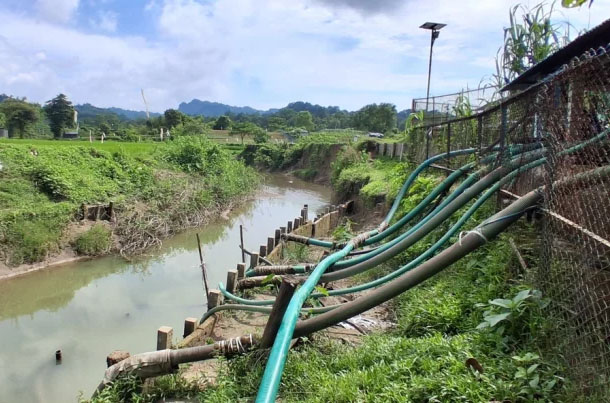
The biggest challenge comes during the dry season. From December, canal water begins to decline and remains low for about five months. During this period, water is brought through a pipeline from an area about five kilometres away, where there are no residents and only a few farmers cultivate land.
The muddy water is first clarified using alum and then disinfected with chlorine. It is subsequently tested at the plant’s own laboratory. Under WHO standards, residual chlorine should remain between 0.2 and 0.5 milligrams per litre.
Water quality is tested at the treatment plant, tap stands and households. A third-party monitoring team also regularly tests water samples.
Two to three checkers and a hygiene team work in the field every day to monitor the system.
From the treatment plant, water is sent to a second storage tank before being distributed through four blocks to 137 tap stands. Water is supplied twice a day, at 7am and 2:40pm.
Three separate tap stands serve the host community, providing safe water to 693 local residents.
Supply falls during dry months
When the canal dries up, the water allocation falls from 20 litres to 15 litres per person.
The WASH sector says the supply should never fall below 10 litres per person. So far, however, the supply has remained above that minimum, with the lowest level recorded at 15 litres.
For residents already struggling to meet their daily needs, even this reduction can have a major impact on bathing, cooking, washing utensils and sanitation.
Host community also benefits
The water crisis has not affected only the Rohingya population.
Host community residents in the area also had to travel long distances to collect water before Oxfam’s treatment plant was established.
Local beneficiaries said families were previously reluctant to marry their daughters into the area because women faced harassment while collecting water in the early morning and evening.
The nearby tap stands, which now provide water twice a day, have significantly reduced the hardship faced by local residents.
Rising population, falling aid
While water remains a critical concern, another challenge is emerging across the camps: the number of people is increasing while international assistance is declining.
Refugee Relief and Repatriation Commissioner (RRRC) Md Mizanur Rahman said the biggest challenge is maintaining the services that already exist.
The Rohingya population is increasing for two main reasons. Continued conflict across the border is driving new arrivals, while around 225,000 children have been born in the camps over the past nine years.
At the same time, international funding is declining.
Maintaining food, education, healthcare and infrastructure services has become increasingly difficult. Many organisations are winding down projects as their funding ends, while assistance from UN agencies has also decreased.
Mizanur Rahman warned that if the trend continues, even ensuring the minimum food supply could become difficult in 2027.
Further cuts in essential services could also create serious law-and-order challenges, he said.
Bangladesh has been hosting around 1.2 million Rohingyas for years. But the country, which is itself struggling to improve the living standards of its own population, cannot continue to shoulder the cost of supporting such a large population from another country indefinitely.
For the refugees, however, the immediate concern remains much simpler: having enough water to drink, cook, bathe and maintain basic hygiene each day.
|